
The Value We Create Creating and providing renewable energy and contributing to the reduction of GHG emissions
Expansion of CSIF's assets
Basic Approach
CSIF and CSAM will help reduce GHG emissions of society as a whole through expansion of their business.
Policy and Direction of Initiatives
CSIF and CSAM will concentrate on continuously expanding AUM based on the approach that the more electricity generated at the solar power plants owned by them, the more they can help reduce GHG emissions.
Medium-Term Management Plan “VISION 2030”
Since the IPO, CSIF has continuously acquired high-quality solar power plants.
As a result, AUM as of the end of June 2024 reached 97 billion yen (acquisition price basis), more than 3.2 times the size at the time of the IPO.
To continue growing and expanding in the future, CSIF set out the Medium-Term Management Plan “VISION 2030" and aims to achieve asset size of 300 billion yen as a 2030 medium-term target.

Management process of climate-related risks and opportunities
Basic Approach
CSIF and CSAM, together with Canadian Solar Projects K.K., a sponsor for CSIF and CSAM, aim to contribute to building a sustainable economic society in local regions while paying attention to the global environment and therefore invest mainly in renewable energy power generation facilities and conduct business with a focus on the environmental aspect among ESG considerations.
■Disclosure of information about climate change initiatives based on the TCFD(Note) Recommendations
Recognizing that climate change is an important environmental issue with potential risks and opportunities for business operations, CSIF and CSAM have decided to disclose information in line with the TCFD recommendations in the areas of governance, strategy, risk management, and metrics and targets.
(Note)TCFD: Task Force on Climate-related Financial Disclosures
Task Force on Climate-related Disclosures: Initiative which was established by the Financial Stability Board (FSB) based on the wishes of G20 Finance Ministers and Central Bank Governors and which recommended that organizations assess and disclose the potential financial impacts of climate-related risks and opportunities.

Governance
CSIF’s Board of Directors supervises action on ESG issues including action on climate change by receiving reports twice a year from the Sustainability Committee.
The Sustainability Committee is chaired by the Representative Director and CEO who is responsible for managing climate-related risks and opportunities. Leveraging the latest knowledge of renewable energy-related policy developments and climate-related disasters, etc., the committee identifies risks and opportunities based on the proposals of business execution departments and provides advice and guidance.

Risk Management
CSIF and CSAM evaluate the importance of solar power generation climate-related risks and opportunities, taking factors such as impact on business, probability of occurrence, connection with business strategies, and level of stakeholder interest into consideration.
The management process for climate-related risks is integrated into the Risk Management Regulations and Risk Management Policy established under the existing Risk Management Framework and identified material risks are managed from diverse perspectives including risk understanding and awareness methods, risk limits, risk mitigation measures (methods for addressing risk), and risk reduction methods on risk discovery.
Strategies
■Identification of risks and opportunities
Risks and opportunities associated with climate change can be divided into “transition risks and opportunities” arising from the transition to a decarbonization society, such as the increased share of renewables in the electricity generation mix, and “physical risks and opportunities” arising from changes in the climate, such as the increased severity of climate-related disasters.
CSIF and CSAM recognize that these risks and opportunities will each materialize at different times and classified them into short, medium and long-term risks (0-5 years, 5-15 years and 15+ years) as shown in the table below.
this table can scroll to sideway
| Category | Key risks and opportunities | Materialization timing | |
|---|---|---|---|
| Transition risks | Regulations | Response to more rigorous assessment of environmental impacts | Short term |
| Decrease in volume of effectricity sales due to output curtailment | Short term | ||
| Market | Dcrease in electricity demand due to shrinking population | Long term | |
| Decrease in electricity demand due to decline of primary material industry | Long term | ||
| Technology | Contraction of commercial market due to expansion of residential market resulting from widespread introduction of distributed enerdy systems | Medium term | |
| Physical Risks | Acute | Rising cost of tracking natural disasters due to increased severity of climate-related disasters | Short term |
| Chronic | Decrease in volume of electricity sales due to changing weather patterns | Short term | |
| Opportunities | Products and Services | Increase in volume og electricity sales as a result of growing demand for renewables | Medium term |
| Market | Increase in volume of electricity sales due to wider range of facilities including floating solar power generation systems and farming type photovoltaic generation systems | Medium term | |
| Growth in electricity demand due to use of electricity in energy-intensive industries, etc. | Medium term | ||
| Technology | Decrease in capital expenditure due to increase in cumulative production volume of solar power generation facilities | Medium term | |
■Scenario analysis
For climate change related risks and opportunities that we identified and organized, we conducted scenario analysis on the following themes which were assessed as having a “high degree of importance,” taking into consideration factors such as impact on business, connection with business strategies, and level of stakeholder interest.
- Impact of increasing severity of climate-related disasters on power plants (flood, high tide, wind damage)
- Increase in volume of electricity sales as a result of growing demand for renewables
- Increase in volume of electricity sales due to wider range of facilities including floating solar power generation systems and farming type photovoltaic generation systems
- Decrease in capital expenditure due to increase in cumulative production volume of solar power generation facilities
Find out more
https://ssl4.eir-parts.net/doc/9284/tdnet/2085629/00.pdf
Metrics and Targets
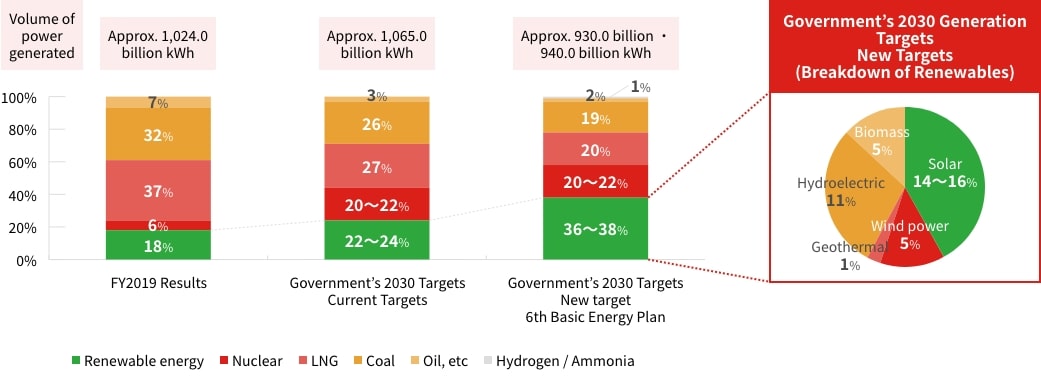
CSIF and CSAM recognize that government decarbonization and energy policy measures are important for investment in and operation of solar power generation facilities, which are their core business. The 6th Basic Energy Plan identifies renewable energy as a major power source and plans to increase the national target for renewable energy in Japan’s power mix to between 36% to 38% by 2030. This is double the FY2019 share (18%). Solar power is expected to be the largest renewable energy source, accounting for a 14-16% share of Japan’s power mix.
Using changes in the solar power share of Japan’s power mix as an indicator for managing future investment policy and risks and opportunities, we will contribute to the creation of a sustainable economy and society.
We also recognize that reduction of electricity sales loss through output curtailment is also important to ensure stable revenue from sales of electricity from solar facilities. To this end, we have been installing online output curtailment systems and we will continue considering gradually shifting to online output curtailment based on an assessment of cost-effectiveness.
| Property number | Name of property | Online curtailment system status |
|---|---|---|
| S-01 | CS Shibushi-shi Power Plant | 〇 |
| S-02 | CS Isa-shi Power Plant | 〇 |
| S-03 | CS Kasama-shi Power Plant | |
| S-04 | CS Isa-shi Dai-ni Power Plant | 〇 |
| S-05 | CS Yusui-cho Power Plant | 〇 |
| S-06 | CS Isa-shi Dai-san Power Plant | 〇 |
| S-07 | CS Kasama-shi Dai-ni Power Plant | |
| S-08 | CS Hiji-machi Power Plant | 〇 |
| S-09 | CS Ashikita-machi Power Plant | 〇 |
| S-10 | CS Minamishimabara-shi Power Plant(East & West) | 〇 |
| S-11 | CS Minano-machi Power Plant | |
| S-12 | CS Kannami-cho Power Plant | |
| S-13 | CS Machiki-machi Power Plant | 〇 |
| S-14 | CS Koriyama-shi Power Plant | |
| S-15 | CS Tsuyama-shi Power Plant | 〇 |
| S-16 | CS Ena-shi Power Plant | 〇 |
| S-17 | CS Daisen-cho Power Plant(A & B) | 〇 |
| Property number | Name of property | Online curtailment system status |
|---|---|---|
| S-18 | CS Takayama-shi Power Plant | 〇 |
| S-19 | CS Misato-machi Power Plant | |
| S-20 | CS Marumori-machi Power Plant | 〇 |
| S-21 | CS Izu-shi Power Plant | 16th(plan-ned) |
| S-22 | CS Ishikari Shinshinotsu-mura Power Plant | 〇 |
| S-23 | CS Osaki-shi Kejonuma Power Plant | 〇 |
| S-24 | CS Hiji-machi Dai-ni Power Plant | 〇 |
| S-25 | CS Ogawara-machi Power Plant | 〇 |
| S-26 | CS Hukuyama-shi Power Plant | 〇 |
| S-27 | CS Shichigasyuku-machi Power Plant | 〇 |
| S-28 | CS Kama-chi Power Plant | 〇 |
| S-29 | CS Miyako-machi Saigawa Power Plant | 〇 |
| S-30 | CS Kasamachi-Dai-san Power Plant | |
| S-31 | CS Yamaguchi-shi Power Plant | 〇 |
| S-32 | CS Sakura-shi Power Plant |
Green Finance
CSIF revised a new Green Finance Framework which obtained a Green1(F) assessment from JCR, the highest assessment rating as of June 30, 2023.
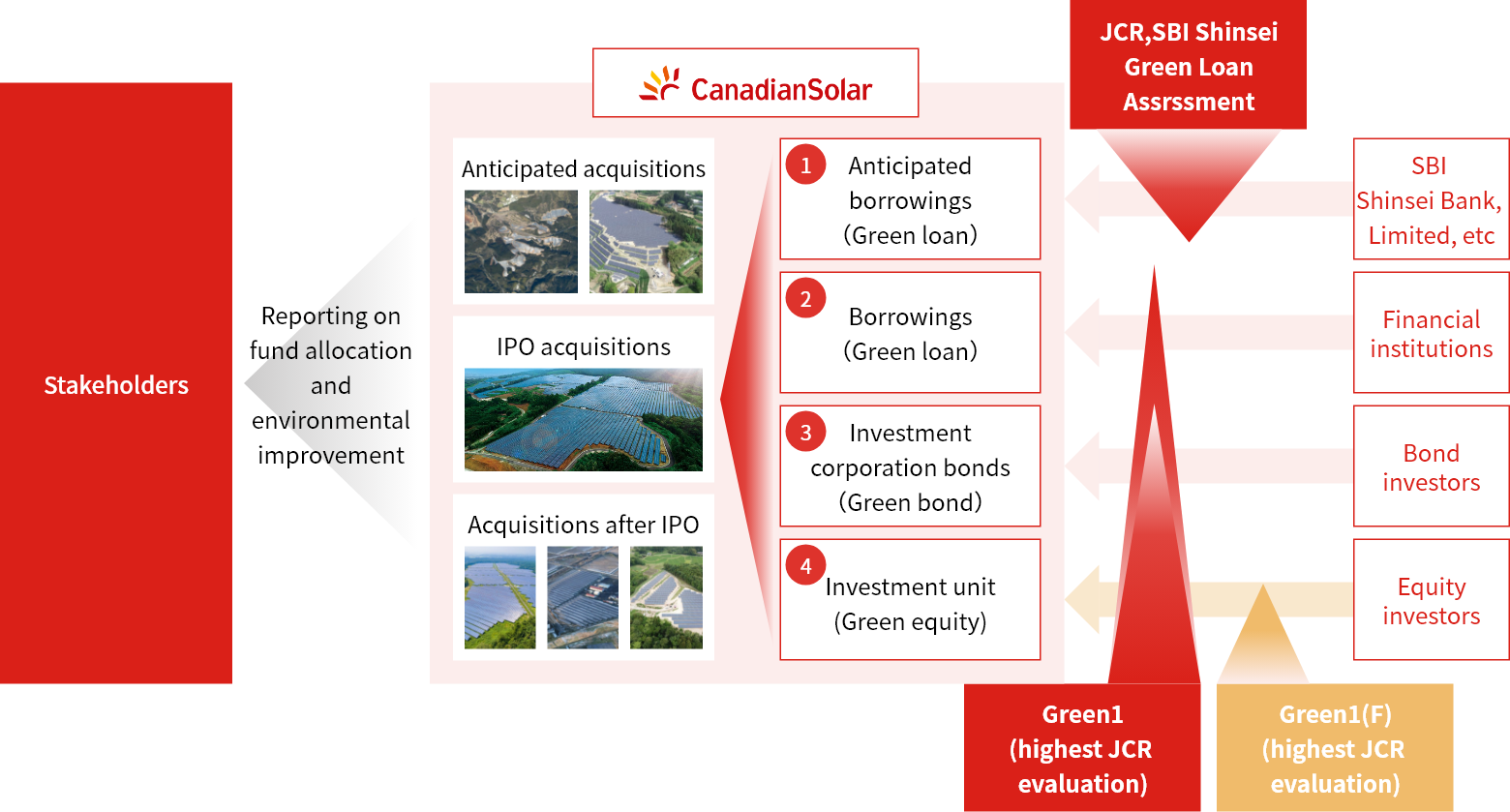
CSIF obtained a Green1 (the highest rating) assessment from JCR and a Shinsei Green Loan Assessment from Shinsei Bank, Limited (Current SBI Shinsei Bank, Limited), which is one of CSIF’s arranger banks, for the borrowings of 17.0 bn yen allocated towards acquisitions during the 8th Fiscal Period (acquired on March 8, 2021). In addition, as a result of review by JCR, indicates the continuation of the same Green1 (the highest rating) assessment as of August 17, 2023.
The borrowings amounting to 15.7 bn yen which was allocated towards the funds for acquiring the acquisitions for the IPO obtained a Green1 (the highest rating) assessment by JCR as of November 22, 2017, based on JCR’s evaluation of the use of proceeds and CSIF’s management / operation / transparency. Also, after an annual review, the borrowings continued to be assessed as Green1 as of August 17, 2023.
And the borrowings amounting to 11.6 bn yen which was allocated towards acquisitions during the 13th Fiscal Period (acquired on July 19, 2023) obtained a Green1 (the highest rating) assessment by JCR as of June 30, 2023.
As of January 26, 2021, CSIF issued a 5-year Green Bond of 3.8 bn yen, which was given JCR Green1 assessment and the proceeds will be used for the repayment of borrowings. Also, after an annual review, the Bond continued to be assessed as Green1 as of August 17, 2023. And as of October 24, 2024, CSIF issued a 5-year Green Bond of 1.4 bn yen.
Simultaneously with this offering, CSIF has revised its Green Finance Framework to make it also applicable to the issuance of investment units. CSIF plans to obtain a third-party evaluation of the revised Green Finance Framework from JCR as of June 30, 2023 for the issuance of investment units as green equity in accordance with the new Green Finance Framework.
Assets eligible for Green Finance (as of December 2024)
this table can scroll to sideway
| Property number | Name of property | Use of funds raised through borrowing/investment corporation bonds |
|---|---|---|
| S-01 | CS Shibushi-shi Power Plant | Property allocated funds from Green Loan 2 above |
| S-02 | CS Isa-shi Power Plant | Property allocated funds from Green Loan 2 above |
| S-03 | CS Kasama-shi Power Plant | Property allocated funds from Green Loan 2 above |
| S-04 | CS Isa-shi Dai-ni Power Plant | Property allocated funds from Green Loan 2 above |
| S-05 | CS Yusui-cho Power Plant | Property allocated funds from Green Loan 2 above |
| S-06 | CS Isa-shi Dai-san Power Plant | Property allocated funds from Green Loan 2 above |
| S-07 | CS Kasama-shi Dai-ni Power Plant | Property allocated funds from Green Loan 2 above |
| S-08 | CS Hiji-machi Power Plant | Property allocated funds from Green Loan 2 above |
| S-09 | CS Ashikita-machi Power Plant | Property allocated funds from Green Loan 2 above |
| S-10 | CS Minami Shimabara-shi Power Plant (East & West) | Property allocated funds from Green Loan 2 above |
| S-11 | CS Minano-machi Power Plant | Property allocated funds from Green Loan 2 above |
| S-12 | CS Kannami-cho Power Plant | Property allocated funds from Green Loan 2 above |
| S-13 | CS Mashiki-machi Power Plant | Property allocated funds from Green Loan 2 above |
| S-20 | CS Marumori-machi Power Plant | Property allocated funds from Green Loan 3 above |
| S-21 | CS Izu-shi Power Plant | Property allocated funds from Green Loan 3 above |
| S-22 | CS Ishikari Shinshinotsu-mura Power Plant | Property allocated funds from Green Loan 3 above |
| S-23 | CS Osaki-shi Kejonuma Power Plant | Property allocated funds from Green Loan 3 above |
| S-24 | CS Hiji-machi Dai-ni Power Plant | Property allocated funds from Green Loan 1 above |
| S-25 | CS Ogawara-machi Power Plant | Property allocated funds from Green Loan 1 above |
| S-26 | CS Hukuyama-shi Power Plant | Property allocated funds from Green Loan 2 above |
| S-27 | CS Shichigasyuku-machi Power Plant | Property allocated funds from Green Loan 2 above |
| S-28 | CS Kama-chi Power Plant | Property allocated funds from Green Loan 2 above |
| S-29 | CS Miyako-machi Saigawa Power Plant | Property allocated funds from Green Loan 2 above |
| S-30 | CS Kasamachi-Dai-san Power Plant | Property allocated funds from Green Loan 2 above |
The reduction of GHG emissions
Basic Approach
By generating more solar renewable energy through expansion in its asset size, CSIF will help reduce the GHG emissions of society as a whole.
Reduction in CO₂ Emissions Through Expansion in Asset Size
Since listing, CSIF and CSAM helped reduce CO₂ emissions by 561,726,671 kg in total through the generation of electricity at the solar power plants they own.
By continuing to increase CSIF's asset size and generate more solar renewable energy, CSIF and CSAM will help further reduce CO₂ emitted by society as a whole.
this table can scroll to sideway
| Number of Power Plant | Solar panel output (MW) |
Volume of power generated (kWh) |
Amount of CO₂ reduction (kg-CO₂) |
|
|---|---|---|---|---|
| Year ended June 30, 2018 | 15 | 75.3 | 57,471,288 | 30,322,149 |
| Year ended December 31, 2018 | 18 | 105.6 | 50,156,955 | 25,732,694 |
| Year ended June 30, 2019 | 20 | 108.9 | 61,581,643 | 33,178,668 |
| Year ended December 31, 2019 | 21 | 119.7 | 58,052,643 | 31,079,950 |
| Year ended June 30, 2020 | 21 | 119.7 | 65,575,444 | 35,172,986 |
| Year ended December 31, 2020 | 23 | 123 | 67,625,153 | 31,957,301 |
| Year ended June 30, 2021 | 25 | 183.9 | 95,178,803 | 40,791,271 |
| Year ended December 31, 2021 | 25 | 183.9 | 99,477,176 | 41,599,914 |
| Year ended June 30, 2022 | 25 | 183.9 | 112,443,183 | 46,967,688 |
| Year ended December 31, 2022 | 25 | 183.9 | 99,893,868 | 42,834,862 |
| Year ended June 30, 2023 | 25 | 183.9 | 90,355,205 | 39,397,574 |
| Year ended December 31, 2023 | 31 | 226.4 | 126,596,205 | 55,735,464 |
| Year ended June 30, 2024 | 31 | 226.4 | 121,393,974 | 52,816,859 |
| Year ended December 31, 2024 | 32 | 227.6 | 123,738,383 | 54,139,291 |
| Total | 1,229,539,923 | 561,726,671 |